
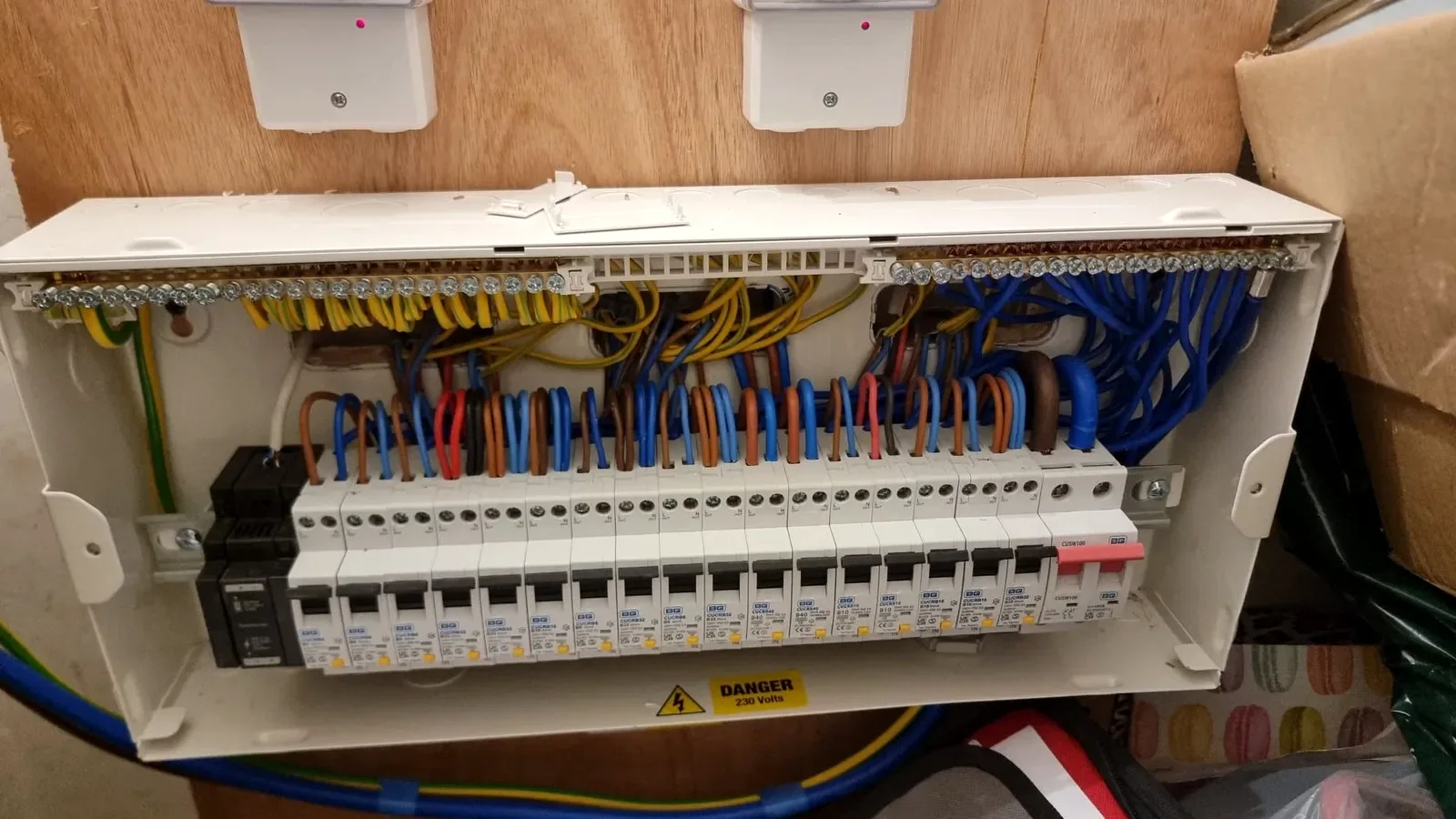
What does a consumer unit do?
The consumer unit, often still called the fuse box or fuse board, is where your electricity supply is split into separate circuits for lights, sockets, the cooker and so on. Each circuit is protected by a fuse or circuit breaker, and modern boards add RCD protection that cuts the power if current leaks to earth, for example through a person.
Signs your fuse box needs replacing
- It has old rewireable fuses with fuse wire, rather than circuit breakers.
- There's no RCD protection, or only some circuits are covered.
- It has a wooden back, a cracked or scorched case, or you notice a burning smell.
- Breakers trip often and no faulty appliance is to blame.
- You're adding an extension, a new kitchen or an EV charger and there's no safe spare capacity.
- An Electrical Installation Condition Report (EICR) has recommended it.
None of these on its own means the board must go. An inspection will tell you whether yours is fine, needs a repair, or should be replaced.
RCDs and RCBOs: what's the difference?
An RCD protects a group of circuits. Many boards use two RCDs, each covering half the circuits, so a fault on one circuit switches off everything in that half. An RCBO combines an RCD and a circuit breaker for a single circuit, so a fault only switches off the circuit it's on. RCBO boards cost more but make faults far less disruptive and easier to trace.
Why new consumer units are metal
Since 2016 the UK wiring regulations (BS 7671) have required consumer units in homes to be housed in a non-combustible enclosure, which in practice means metal. If your board is plastic and fitted before then, that alone doesn't make it unsafe, but any replacement will be metal.
The current regulations also call for surge protection devices in most new installations, to protect electronics from voltage spikes, and new boards are usually fitted with one.
What happens on the day
- The existing circuits are tested first, so any faults are found before the new board goes in.
- The power is switched off and the old board removed. Most homes are without power for much of the day.
- The new board is fitted, every circuit connected and clearly labelled.
- Everything is tested, and you're given an Electrical Installation Certificate.
Replacing a consumer unit is notifiable work under Part P of the Building Regulations in England. It must be done by an electrician registered with a competent person scheme, who notifies building control for you, or be notified to building control before the work starts. Keep the certificates: buyers and insurers may ask for them.
Why does my new board keep tripping?
Modern RCD protection is more sensitive than old fuses, so it can reveal faults that were already there, such as damp in an outdoor socket or light, or a faulty appliance. That's the new board doing its job. Testing before the swap helps find these early.
Need a hand?
E.A Electrician Ltd is a North London electrical company based in Wood Green, N22, rated 5.0 from 32 Google reviews. See our consumer unit upgrades service, or call 07871 056970 for a free estimate.
Quick answers
How do I know if my fuse box needs replacing?
Common signs are rewireable fuses, no RCD protection, scorch marks or a burning smell, frequent tripping, or a board that can't safely take new circuits. An inspection will confirm it.
How long does a consumer unit change take?
Most domestic swaps take around a day, with the power off for much of that time.
Is replacing a consumer unit notifiable?
Yes. In England it's notifiable work under Part P of the Building Regulations, so it has to be certified and notified to building control.
Published by E.A Electrician Ltd. Last updated 31 October 2026.