
When should you plan the lighting?
Before first fix. First fix is when the electrician runs cables and fits back boxes, before plasterboard goes up and walls are skimmed. Every light position, switch and dimmer has to be decided by then. Moving things afterwards is possible, but it means cutting into finished walls and ceilings.
If you're working with a builder, ask when first fix is booked and work back from that date. If you have an interior designer, get them and your electrician talking early.
Think in layers, not just downlights
The rooms that feel best use more than one kind of light. Most well-lit rooms combine three or four of these layers:
- Ambient: the general light for the room, usually downlights or a ceiling light.
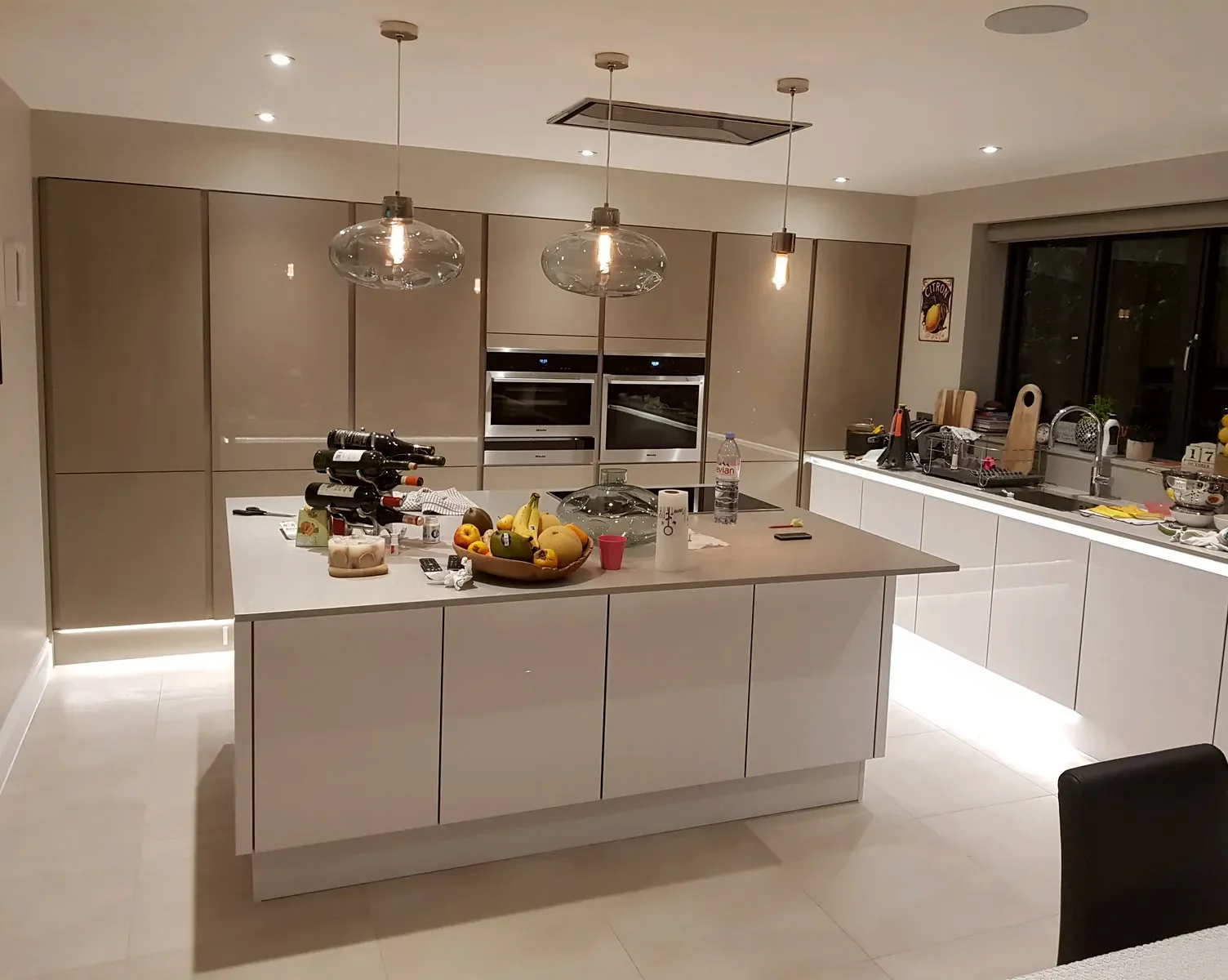
- Task: light where you work, such as over a kitchen island, under wall cabinets or around a bathroom mirror.
- Accent: LED strips in ceiling coffers, coves, shelving and stair treads, or picture lights, which give a room depth.
- Decorative: pendants, chandeliers and wall lights that are part of the design.
Put the layers on separate circuits and you can mix them for different moods: bright for cooking, low and warm for the evening.
Switching and dimming
Decide where you'll be standing when you want each light on. Stairs, landings, long hallways and rooms with two doors usually need two-way switching, so you can turn the light on at one end and off at the other.
Dimmers need to be compatible with the LED lamps or drivers they control. A mismatched dimmer is the most common cause of flickering or buzzing LED lights, so it's worth choosing fittings and dimmers together.
LED strip lighting: plan the driver
LED strips run at low voltage from a driver (a small transformer). Drivers eventually need replacing, so plan where each one goes and make sure it stays accessible, for example in a cupboard, a loft space or behind a removable panel, rather than sealed behind plasterboard.
Fitting the strip inside an aluminium profile with a diffuser gives a smooth, even line of light instead of visible dots, and helps the LEDs last.
Colour temperature and colour quality
Colour temperature is measured in kelvin (K). Warm white, around 2700K to 3000K, suits living rooms and bedrooms. Whatever you choose, keep it consistent within a room so the layers match.
Look at the colour rendering index (CRI) too. A CRI of 90 or above shows colours more naturally, which matters in kitchens, bathrooms and dressing areas.
Bathrooms have extra rules
Bathrooms are divided into zones around the bath and shower. Light fittings in zone 1, directly above the bath or shower up to 2.25 metres, must be rated at least IPX4 against water, and many electricians fit IP65-rated downlights over showers. Circuits serving a bathroom also need 30mA RCD protection. Your electrician will check the zones before you buy fittings.
Your lighting checklist before first fix
- Which layers of light does each room need?
- Where will every switch and dimmer be, and which lights does each control?
- Do you need two-way switching on stairs and in hallways?
- Where will the LED drivers go, and can you get to them later?
- Have you chosen fittings and dimmers that work together?
- Are outdoor lights and garden circuits included, before paving or decking goes down?
Need a hand?
E.A Electrician Ltd is a North London electrical company based in Wood Green, N22, rated 5.0 from 32 Google reviews. See our lighting design & installation service, or call 07871 056970 for a free estimate.
Quick answers
When should I plan the lighting for an extension?
Before first fix, when the cables are run and before plastering. That's when every light, switch and dimmer position needs to be decided.
Why do my LED lights flicker on a dimmer?
Usually because the dimmer isn't compatible with the LED lamps or driver. Choosing dimmers and fittings that are designed to work together normally fixes it.
What colour temperature should I use at home?
Warm white, around 2700K to 3000K, suits most living spaces. Keep it the same within each room.
Published by E.A Electrician Ltd. Last updated 31 October 2026.